
A 22-year-old man was arrested in Mirzapur, Uttar Pradesh, for allegedly kidnapping a young woman and attempting to forcibly convert her religion. The arrest followed a complaint by the woman's mother, leading to charges under the Bharatiya Nyaya Sanhita and the Uttar Pradesh Prohibition of Unlawful Conversion of Religion Act.

West Bengal Chief Minister Suvendu Adhikari announced plans to enact a stringent law against religious conversion and implement the Uniform Civil Code (UCC) in the state. He linked these measures to strengthening national security and preserving Bengal's cultural identity, citing concerns over infiltration and demographic changes. Adhikari also highlighted efforts in border security, distinguished between illegal immigrants and CAA refugees, and paid tribute to Bankim Chandra Chattopadhyay.

The Chhattisgarh government has introduced a bill in the state assembly to prevent religious conversions carried out through force, inducement, fraud, or misrepresentation. The bill, titled the Chhattisgarh Dharm Swatantraya Vidheyak, 2026 (Freedom of Religion Bill, 2026), aims to curb conversions achieved through coercion or undue influence.
The Chhattisgarh government has introduced a bill aimed at preventing religious conversions through force, inducement, or misrepresentation, sparking opposition and debate in the state assembly.
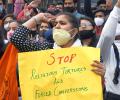
The Maharashtra government plans to introduce a stringent anti-conversion law in the winter session of the legislature, with provisions stricter than those in other states.
The Supreme Court has sought responses from the Centre and 12 states on a PIL challenging the validity of their anti-conversion laws. The National Council of Churches in India (NCCI) filed the PIL, seeking a stay on the operation of these laws.
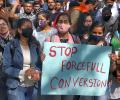
The Supreme Court has agreed to hear a plea challenging the validity of the Rajasthan Prohibition of Unlawful Conversion of Religion Act, 2025, potentially impacting religious freedom and state legislation.
The Supreme Court has declined to urgently hear pleas seeking a stay on anti-conversion laws enacted by several states, including Uttar Pradesh, Gujarat, and Madhya Pradesh. The matter is now scheduled for hearing in December.
The Supreme Court on Monday said it would hear on February 3 a batch of pleas challenging controversial state laws regulating religious conversions due to interfaith marriages.
The Supreme Court on Monday said that it will hear on March 17 pleas dealing with two separate issues of alleged 'fraudulent conversions' and challenge to various state laws on religious conversions due to interfaith marriages respectively.
Two individuals have been arrested in Muzaffarnagar, Uttar Pradesh, for allegedly carrying out unlawful religious conversions, sparking an investigation and legal proceedings.
"There are people who get converted and do not disclose that they have converted. They take double benefits," RSS general secretary Dattatreya Hosabale said at a press conference."

Maharashtra Chief Minister Devendra Fadnavis announced the formation of a committee of women legislators to amend laws and ensure effective implementation against harassment and religious conversion in the corporate sector. This decision follows an incident at a TCS unit in Nashik involving alleged exploitation and forced conversion, which is currently under SIT investigation. Probes have also been ordered into similar complaints at a Spanish multinational in Pune and a government ITI in Solapur, highlighting a broader issue of workplace misconduct.

The Madhya Pradesh cabinet on Saturday approved the Religious Freedom Bill 2020, which provides for prison term of up to 10 years and fine of Rs 1 lakh for conversion through marriage or by any other fraudulent means, state Home Minister Narottam Mishra said.
The Supreme Court has sought the Uttar Pradesh government's response on a plea challenging certain provisions of the 2024 amended UP law on unlawful religious conversion, citing concerns about free speech and religious propagation.

The Maharashtra assembly has passed the Freedom of Religion Bill 2026, introducing strict measures to prevent religious conversions through coercion, fraud, or marriage, sparking debate over constitutional rights and religious freedom.

A court in Nashik has extended the police custody of four TCS employees until May 2 in connection with the alleged religious conversion of a male colleague. The accused are also facing accusations of sexual harassment from female colleagues.
Forced religious conversion may pose a danger to national security and impinge on the religious freedom of citizens, the top court had said recently and asked the Centre to step in and make sincere efforts to tackle the "very serious" issue.

Chhattisgarh Deputy Chief Minister Vijay Sharma announced plans for a new anti-conversion law following the arrest of two nuns from Kerala on charges related to religious conversion and human trafficking. The announcement comes amid political tensions and accusations of wrongful arrest.

UN experts have voiced serious concerns regarding the ongoing abduction and forced religious conversion through marriage of women and girls from minority communities in Pakistan, highlighting that impunity is fuelling the practice.

Indulging in religious conversion with inducement or under pressure is an "unpardonable offence", the state home minister Araga Jnanendra said adding, it may also lead to disturbance of peace in the society.

Maharashtra Chief Minister Devendra Fadnavis stated his government is confident of uncovering the module involved in the alleged sexual harassment and forcible religious conversion at a Tata Consultancy Services (TCS) unit in Nashik.

TCS has denied receiving any complaints of religious conversion or sexual misconduct at its Nashik unit through its internal channels, amid a police probe into the allegations. The company has announced an oversight panel and engaged external entities in its internal investigation.
Maharashtra Chief Minister Devendra Fadnavis has ordered probes into multiple allegations of sexual harassment and forced religious conversion at a Spanish multinational in Pune, a government-run ITI in Solapur, and a TCS unit in Nashik. The CM highlighted a pattern of such incidents in corporate firms and suggested forming a panel of women legislators to review existing laws and recommend improvements.

The Maharashtra government has introduced the Maharashtra Freedom of Religion Bill 2026, which aims to prohibit religious conversions carried out through coercion, fraud, or marriage, with stringent penalties for violations.

The state assembly had passed the Haryana Prevention of Unlawful Conversion of Religion Bill in March this year.

Nida Khan, a TCS employee accused of religious conversion and sexual harassment, has been arrested in Chhatrapati Sambhajinagar. Police allege an AIMIM corporator provided her shelter. The arrest has sparked political reactions and renewed focus on workplace harassment prevention.
Terming forced religious conversion a "very serious" issue, the Supreme Court on Monday asked the Centre to step in and make sincere efforts to check the practice.
The Supreme Court on Friday sought response from the Centre and others on a plea seeking direction to take stringent steps to control fraudulent religious conversion by "intimidation" and through "gifts and monetary benefits".
The Rashtriya Swayamsevak Sangh on Wednesday accused the Biju Janata Dal-Bharatiya Janata Party government in Orissa of working under "pressure" from missionary elements and the Centre to protect real "killers" of Vishwa Hindu Parishad leader Laxmanananda Saraswati and demanded a central law to ban religious conversion.

Justice Renu Agarwal made the observation while rejecting a Hindu-Muslim couple's plea for police protection.

Police are searching for a TCS employee, Nida Khan, in connection with alleged forced conversions at the company's Nashik unit. This follows allegations of sexual harassment and religious coercion at the TCS facility, where several arrests have already been made.
A bench of Justices R F Nariman, B R Gavai and Hrishikesh Roy told senior advocate Gopal Sankaranarayana, appearing for petitioner advocate Ashwini Upadhyay, "What kind of writ petition is this under Article 32. We will impose a heavy cost on you. You argue on your own risk."

A married man and his parents have been booked for allegedly abducting a girl student from Kolkata, forcing her to convert to another religion, and then marrying her, a senior police officer said on Friday.

Based on a complaint from Tikaram, a resident of Sharif Nagar village in Devarniya, the case was registered under sections of the Indian Penal Code and the anti-conversion law.
Punjab Chief Minister Bhagwant Mann has accused the central government of providing 'VIP treatment' to gangster Lawrence Bishnoi, criticising perceived double standards in dealing with crime.

Maharashtra minister Sanjay Shirsat has called for a police investigation into the alleged involvement of AIMIM and its ex-MP Imtiaz Jaleel in the Nashik TCS case, following the arrest of accused Nida Khan. Shirsat alleges AIMIM is encouraging religious conversions and that Khan is part of a larger network.
Three years ago, the accused started exerting pressure on her to undergo religious conversion and perform 'nikaah' (marriage). But when the woman opposed, he threatened to kidnap her, Tikaram alleged.
Noida Police have suspended two officers for failing to include key legal provisions in a rape case FIR, including those related to unlawful religious conversion and the SC/ST Act.
A court in Maharashtra's Nashik district on Monday fixed May 2 for giving its verdict on the anticipatory bail plea filed by TCS employee Nida Khan, an accused in a case related to alleged sexual harassment and forcible religious conversion at the IT firm's local unit.
